
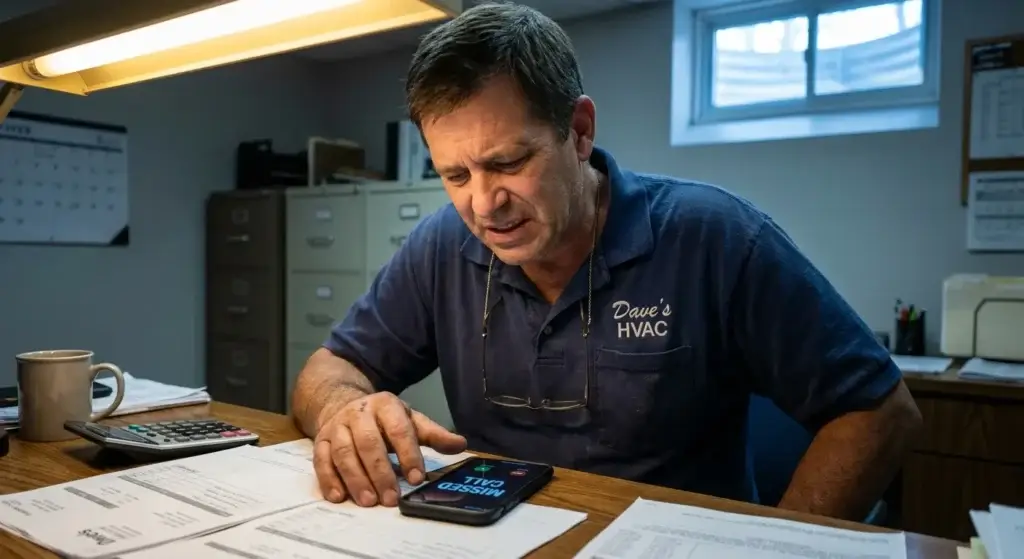
The missed call cost for a typical trade business runs between $1,200 and $4,500 per month in lost jobs, and most owners have no idea the leak is that big because the leads never show up anywhere. They just call the next guy. Your voicemail is quietly the most expensive line item in your P&L.
Here is the math most owners never run on themselves. We will walk through it with real numbers from tree, HVAC, plumbing, and electrical shops, then show you what the fix actually looks like.
How to Calculate Your Own Missed Call Cost
You need three numbers. Pull them from your phone bill, your closed job list, and your average invoice.
- How many inbound calls hit your phone last month. Most carriers show this in the online account. Count only inbound.
- How many of those went to voicemail. Same place, usually under call history. If your carrier does not break it out, assume 35% for a solo owner-operator in the field. That number comes from averaging what we see across the trade accounts we run.
- Your average closed job value. Last 20 invoices, add them up, divide by 20.
Now the formula. Take your missed calls, multiply by 0.40, that is roughly how many were real buying prospects (the rest are spam, wrong numbers, existing customers calling about scheduling). Then multiply that by your close rate on calls you actually answer, usually 30% to 50% for the trades. That gives you the number of jobs you lost. Multiply by your average job value.
Example: an HVAC shop takes 180 inbound calls a month. 63 go to voicemail. 63 x 0.40 = 25 real prospects. 25 x 0.40 close rate = 10 lost jobs. 10 x $650 average ticket = $6,500 a month gone. That is $78,000 a year sitting in a voicemail box nobody checks until Sunday night.

What Industry Data Says About Missed Call Rates
Research from BIA Advisory Services found that small businesses lose roughly $75 billion a year collectively from unanswered calls, with service businesses taking the worst hit because the buyer is in a decision window of about 10 minutes before they call the next company on the list.
Breakouts by trade from what we track:
- Tree service: 40% to 50% miss rate. Owners are up in the bucket, on a chainsaw, or driving between jobs with the phone in the console. Average ticket $800 to $4,000. Monthly leak: $2,000 to $8,000.
- HVAC and plumbing: 30% to 40% miss rate when a solo tech is on a service call. Average ticket $400 to $1,200. Monthly leak: $1,800 to $5,500.
- Electricians: 35% miss rate. Average ticket $350 to $1,500. Monthly leak: $1,500 to $4,200.
- Landscaping and hardscape: seasonal spike to 55% miss rate in spring. Average ticket on hardscape runs $3,000 to $15,000, so even one missed call a week is a $12,000-a-month leak in May and June.
Why Most Guys Handle This the Wrong Way
The common answers all cost more than the problem.
Hire an answering service. $300 to $600 a month, reads a script, cannot answer trade questions, pisses off the caller because the person on the other end does not know what a 240 breaker is or what crown reduction means. Conversion from an answering service back to a booked job is usually under 15%.
Hire a part-time office person. $2,500 to $4,000 a month loaded. Great if you have the volume, but a solo owner doing $25k a month in revenue cannot carry that overhead.
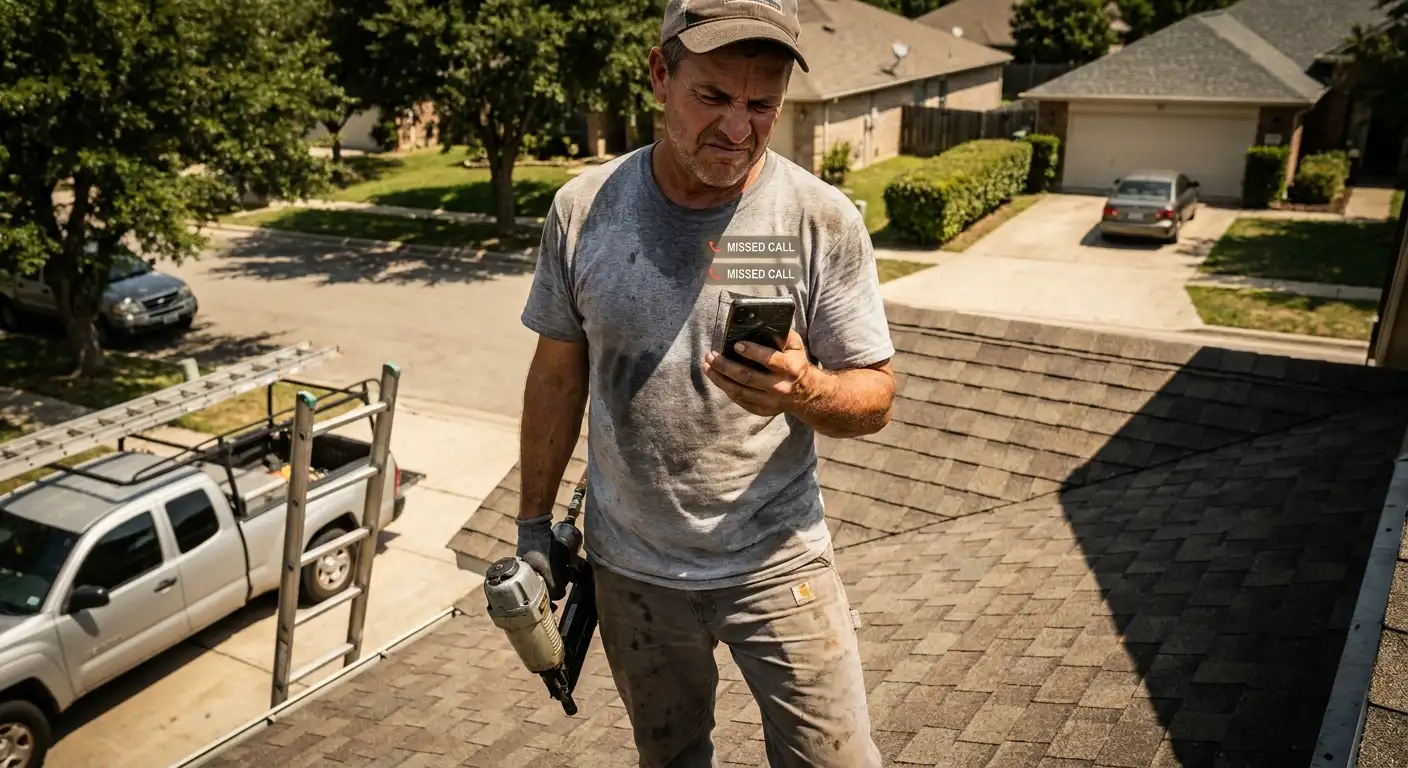
“I’ll just call them back faster.” You won’t. You are on a roof. By the time you get down, listen to the voicemail, and dial back, they already hired the next guy on Google.
The Fix That Actually Works for a One-Truck Operation
An AI voice agent that answers every call 24/7, asks your three qualifying questions in your voice, and texts you the job summary before you climb down the ladder.
It picks up on the first ring. It confirms what the customer needs. It asks for the address, the scope, and when they want it done. Then it either books them straight into your calendar or hands you a text that says: “John in Vernon, oak removal near the house, wants an estimate this week, 860-555-0142.”
Most owners we set this up for stop missing jobs inside the first week. Not because they got better at answering the phone, but because they stopped having to. The system does it.
Pricing matters here. The industry benchmark for an “AI receptionist” from the big SaaS players runs $500 a month and up. The version we run on our stack is a fraction of that, and it is tuned for the trades, not for a dentist office. It knows the difference between a dead tree and a hazard tree, between a service call and an install.
What to Do This Week
Run the three numbers above on your own phone. If your missed call cost comes in over $1,500 a month, you have the budget to fix it ten times over and still pocket the difference.
If you want help getting this set up for your shop, we handle the whole stack through our custom software and CRM builds and tie the voice agent directly into your follow-up and booking flow. Specific setup varies a bit by trade, we have a few trade-specific pages that walk through what the system looks like for your work, including tree service.
The jobs are already calling you. The question is whether anyone is picking up.