
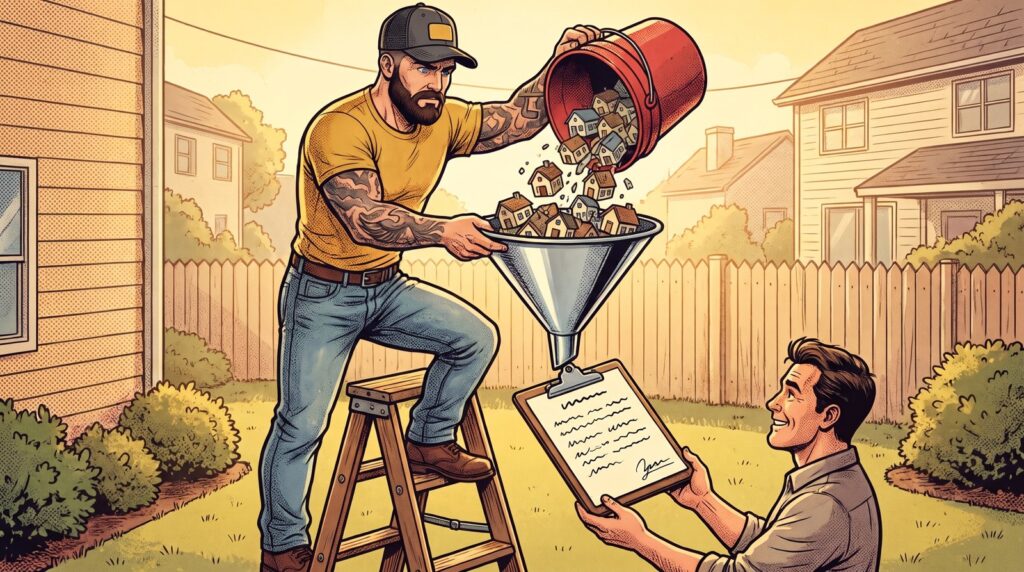
A roofing sales funnel is the path a homeowner takes from finding you to signing the contract: they find you, they contact you, you inspect the roof, you send the quote, they sign. The funnel that books more roofs is not the one with the most traffic at the top. It is the one that loses the fewest people between those five steps. For most roofers the leaks are the same three: the lead that comes in after hours, the callback that happens too late, and the quote nobody follows up on.
This post walks each stage, shows where the jobs fall out, and uses real numbers from businesses we work with. None of them are roofers, so we will say plainly which numbers they are and why they still apply to a roofing company.
The five stages of a roofing sales funnel
- Found. A homeowner sees a missing shingle after a storm, or a water stain on the bedroom ceiling. They search, they land on your site or your Google listing.
- Contacted. They call, text or fill in a form. Or they do not, and they call the next roofer.
- Inspected. Somebody gets on the roof, takes photos and writes the job up.
- Quoted. The estimate goes out.
- Signed. They say yes, put down the deposit and get on the schedule.
Every roofer already has all five. The question is how many people make it from one step to the next, and what happens to the ones who stall.
Stage 1 and 2: most visitors never pick up the phone
One of our clients, a dumpster rental company in Connecticut, had about 278 website visits and got 2 online bookings out of them. That is not a roofing number, but the lesson carries straight over. People were looking. Almost none of them took the next step.
The same company found that 7 of its 8 online checkouts happened outside office hours. That is the part every roofer should sit with. Homeowners look at their roof problem at night and on the weekend, when they are home and the stain on the ceiling is staring at them. If the only way to reach you is a phone that goes to voicemail after 5, most of those people are gone by morning.
So the top of a roofing funnel needs three things before it needs more traffic:
- A phone number at the top of every page that someone, or something, answers at 9pm.
- A short form that asks for the address and what they are seeing, not twelve fields.
- A clear next step: “Book a roof inspection,” not “Contact us.”
We wrote more about the traffic side of this in how to generate roofing leads and the website side in turning website visitors into booked jobs.
Stage 3: book the inspection on the first conversation
Most guys handle a new roofing lead like this: the call comes in while they are up on another roof, it goes to voicemail, and they call back at the end of the day from the work truck. By then the homeowner has called two other roofers. Whoever got them on the phone first usually got the inspection.
The fix is not calling back faster from the ladder. The fix is that the first conversation happens without you. The questions are the same every time: what is going on with the roof, how old is it, is anything leaking inside, what is the address, when can someone come look. That is exactly why a machine should ask them, not you. A voice agent picks up the call, asks those questions, offers inspection times from your calendar, and texts you the summary. A missed call gets a text back within a minute. The homeowner leaves the conversation with an inspection on the books instead of a voicemail.
Stage 4: the quote has to get opened
This is where roofers lose the most money, because the inspection already cost you a truck roll and an hour on the roof.
We pulled 209 residential estimates that one of our clients, a landscaping and snow company here in Connecticut, sent over six months. Different trade, but the same kind of homeowner deciding on the same kind of quote. Here is what they showed:
- Customers who opened the estimate said yes 56% of the time. Customers who never opened it said yes 16% of the time.
- Half of all yeses came within about 3 days of the quote going out.
- 90% of the yeses came within 16 days.
A 16% close rate on unopened quotes is not a price problem. Those people never saw the price. Most estimating software emails a link, and that email lands in a promotions tab or an inbox the homeowner checks once a week. Send the quote by text as well as email, from a number they recognize, and watch whether it gets opened. If it has not been opened in a day, resend it by text.
Stage 5: big jobs need a person
The same company’s estimates showed the other thing every roofer already feels: the bigger the job, the harder it closes. Under $5,000, about one in three said no. Between $5,000 and $15,000, 47% said no. Over $15,000, 73% said no, and most of those lost big jobs were first-time customers who had never hired the company before.
A full roof replacement is a big-ticket job for almost any homeowner, and most of your replacement leads are strangers. Nobody signs for a new roof because of a well-written email. On those quotes the follow-up is a phone call while the quote is open on their screen, a second visit to walk the photos with both homeowners, and a straight answer to the question they are too polite to ask: why is your number higher than the other guy’s?
One more thing from that data. Their quoting software sent an automatic email on day 10 telling the customer the quote had concluded, while 10% of the yeses came after day 16. Check what your own software sends. Roofing decisions wait on insurance adjusters, a spouse, a second quote and the weather. Do not let your software close the door on a buyer who is still deciding.
A roofing follow-up sequence that keeps the funnel moving
- Inspection day: photos of what you found go to the homeowner by text, so they see the problem, not just a number.
- Quote day: send it by text and email.
- When it is opened: a call task for you or your office, same day.
- Day 3: a short text: “Any questions on the roof quote? Happy to walk you through the photos.”
- Day 7: something useful, like a finished job on a similar house nearby.
- Day 14: one direct ask: “Still want to get this on the schedule before winter?”
- If they say no: one call to ask why. Then stop.
Everything stops the moment they reply or sign. We go deeper on timing in how to follow up with prospects.
Why most roofers run this from memory, and what to do instead
Most guys run the whole funnel out of their head and their phone’s call log. The inspection gets done, the quote goes out at night, and follow-up happens if you think of it between tear-offs. That is not a discipline problem. You were on a roof. Nobody remembers to send a day-7 text to fourteen homeowners.
When Profit Revive builds this for a business, the pieces run on their own: calls and texts get answered around the clock, inspections get booked onto the calendar, quotes go out by text and email, an opened quote turns into a call task, the follow-ups send themselves, and everything stops when the homeowner replies. The owner does the part a machine cannot do: stands in the driveway and earns the trust. After we built the site, the CRM and the follow-up for Denison Tree Removal, their November went from $19,000 to $113,000+ year over year.
Quick answers
What is a roofing sales funnel?
It is the path from a homeowner finding you to a signed contract: found, contacted, inspected, quoted, signed. A good one loses as few people as possible between those steps, especially after hours and after the quote goes out.
Where do roofing companies lose the most leads?
In the gaps. Calls that go to voicemail at night, callbacks that come after the homeowner already booked someone else, and quotes that never get opened or never get a follow-up. In the estimates we studied, opened quotes closed at 56% and unopened ones at 16%.
How long should a roofer follow up on a quote?
About two weeks, with touches on quote day, day 3, day 7 and day 14, plus a call as soon as a big quote is opened. In the 209 estimates we studied, 90% of the yeses came within 16 days.
Do I need more leads or a better funnel?
Fix the funnel first. If after-hours leads go unanswered and quotes go out without follow-up, more traffic just means more jobs lost at the same points. Close the gaps, then buy traffic.
Get the funnel built for your roofing company
You already pay for every lead with your ads, your truck wrap and your time on the inspection. The goal is to stop losing them between the first call and the signature. If you want a system that answers, books, quotes and follows up while you are on the roof, apply to become a partner and we will show you how it would run with the leads you already get.