
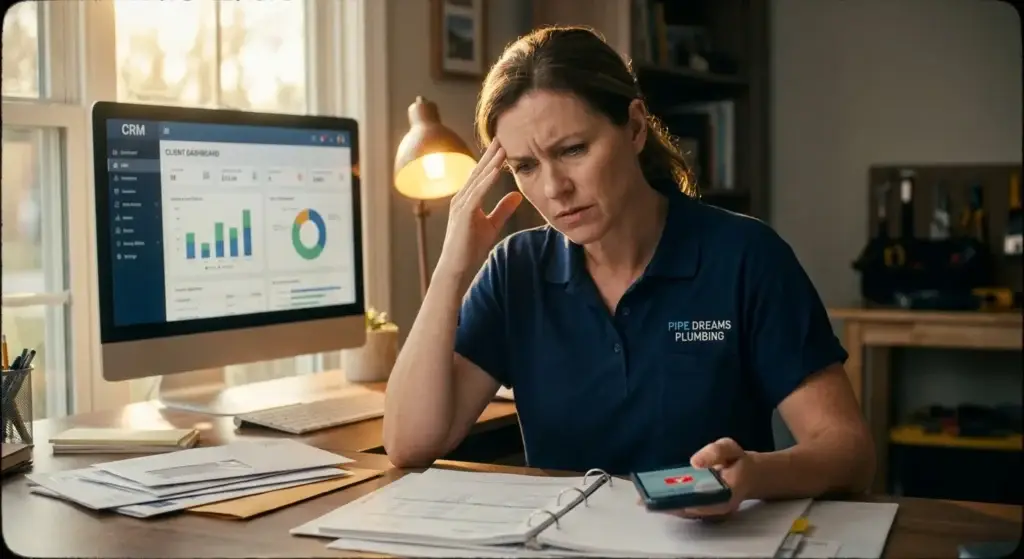
Losing leads is almost never about the ads. A plumber in Hartford spent $1,800 on Google Ads last month, got 47 form fills and phone calls, and booked nine jobs. He thought his ad agency was ripping him off. We pulled his call log. 31 of those 47 leads never got a callback. Not a bad one. None at all.
That is the real story behind almost every “marketing is not working” complaint we hear from local service owners. The marketing is working. The follow-up is broken. And every lead that goes cold is money the owner already paid to acquire, walking straight to a competitor who picked up the phone.
Why Local Service Businesses Keep Losing Leads Even When Marketing Is Working
Here is what actually happens during a normal week at a tree company, an HVAC shop, or an electrical contractor. Leads come in through the website form, the Google Business Profile, a Facebook ad, a yard sign, a referral. The owner is on a roof, in a crawlspace, or 40 feet up a maple. The office manager, if there is one, is buried in invoicing. The voicemail box is full. The form submissions sit in an inbox nobody opens until 7 p.m.
By the time someone calls back, the homeowner has already booked the second or third company they contacted. According to a Harvard Business Review study, businesses that contact a lead within an hour are seven times more likely to qualify that lead than those that wait even one hour longer. Most trade shops respond in 12 to 48 hours, if at all.

That gap is where the money disappears. Not in the ad budget. Not in the website. In the silence between “lead arrives” and “human picks up the phone.”
What Happens to a Lead When No One Follows Up Within the First Hour
A lead is a moment of intent. The homeowner has a problem right now. The breaker keeps tripping. The tree is leaning toward the house. The AC quit on the hottest day of the year. They are sitting at the kitchen table with their phone, ready to spend money.
In the first five minutes after they hit submit, they are yours to lose. By minute 30, they have called two more companies. By the next morning, they have a quote from someone else and you are a missed text on a list.
This is what losing leads actually looks like in practice:
- Form fill at 2:14 p.m. on Tuesday, callback Wednesday at 4 p.m. The homeowner already paid a deposit to your competitor on Tuesday at 3:30 p.m.
- Missed call from an unknown number at 9:47 a.m. No voicemail. No text follow-up. The lead never calls back because they assume you are too busy.
- Facebook lead form submitted Saturday. Owner does not check leads until Monday morning. By then the homeowner has already had three quotes.
- Google Business Profile message sent Sunday night. Notification buried under 200 other emails. Reply sent Thursday. Job already booked elsewhere.
Every one of those leads was paid for. Either in ad spend, SEO investment, time spent earning referrals, or money spent ranking the Google Business Profile. The lead got delivered. The system on the receiving end was the leak.
How to Stop Losing Leads to Competitors Who Respond Faster
The fix is not “hire someone to answer the phone.” That is expensive, it does not cover nights or weekends, and a person cannot respond in 30 seconds while running an estimate. The fix is a system that responds before a human can.
Here is what an actually working follow-up system does in the first five minutes of a new lead:
- Sends an automatic text from the business number within 60 seconds, acknowledging the inquiry by name and asking one qualifying question.
- Sends an email confirmation with a scheduling link so the homeowner can book themselves into the owner’s calendar without waiting.
- Notifies the owner on his phone with a one-tap callback button. No app to open. No CRM to log into.
- If no human responds within 10 minutes, the system follows up again. And again at 30 minutes. And the next morning. And two days later. Until the lead either books, declines, or hits a hard stop.
This is not theoretical. Denison Tree Removal in New London County, Connecticut went from $19,000 in November revenue to over $113,000 the following November after installing exactly this kind of system. Same crew. Same service area. Same Google ranking. The only thing that changed was what happened in the first hour after a lead came in.
What the Simplest System Looks Like in Practice
You do not need 14 software subscriptions. You need one CRM that handles texting, email, calendar booking, missed-call-text-back, and review requests in a single workflow. For most local trades, this means a setup that does the following without anyone touching it:

1. Missed Call Auto Text Back
Every missed call triggers an instant text from the business number: “Hey, this is Mike at [Company]. Sorry I missed you. What can I help with?” That single text recovers 20 to 40 percent of missed calls in most trade shops. It costs nothing once it is set up.
2. Web Form to Text in 60 Seconds
The moment someone fills out a form on the website, they get a text. Not an email they will never open. A text. Most people reply within five minutes because their phone is in their hand.
3. Multi-Step Follow-Up Sequence
If the lead does not respond to the first text, the system sends another the next morning, an email two days later, and a final text three days after that. Most leads need three to five touches before they book. Almost no owner sends three to five touches manually.
4. Self-Scheduling Link
Homeowners can book an estimate slot from their couch at 10 p.m. on a Sunday. The owner wakes up Monday to a calendar that filled itself overnight.
5. Review Request After Job Completion
Two hours after the job is marked complete, the system texts the customer a review link. This is how local trade businesses go from 12 Google reviews to 200 in a year, which feeds the entire flywheel back into more leads.
Why Most Owners Never Build This System Themselves
Because they are good at the trade, not at software. The CRM market is a swamp of half-built tools that all promise the same thing and require six months of configuration. Most owners try one, get frustrated, and go back to texting from their personal phone.

That is what REVA was built to fix. It is the operating system that runs all of this without the owner having to learn anything. The website, the CRM, the automations, the review requests, the missed-call-text-back, the follow-up sequences. One system, configured for the trade.
The Math on Stopping the Bleed
Most trade shops we work with are generating between 60 and 200 leads per month from existing marketing. They close somewhere between 15 and 30 percent of them. If you take a shop closing 20 percent of 100 leads at an average ticket of $1,200, that is 20 jobs and $24,000 a month.
Now plug the leaks. Even a modest 50 percent improvement in response speed and follow-up consistency typically lifts the close rate from 20 percent to 30 percent. Same 100 leads. Now 30 jobs. $36,000 a month. An extra $144,000 a year. With no new ad spend, no new website, no new SEO work.
That number is not a sales pitch. It is the math of what happens when the leads you already paid for stop falling through the floor.
The Bottom Line
If you are losing leads, the first place to look is not your marketing budget. It is the silence between when a lead comes in and when a human responds. Plug that gap with a system that runs whether you are on a roof, in a crawlspace, or asleep. The leads are already there. Stop letting them go cold.