
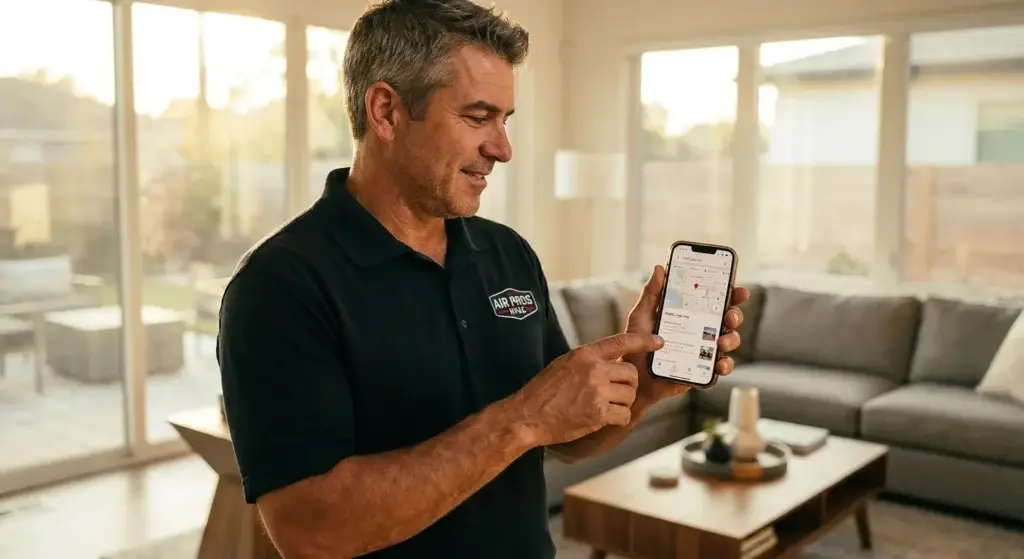
HVAC local SEO is the difference between the phone ringing at 2pm on a 95-degree day and watching your competitor’s van pull into your customer’s driveway. When a homeowner’s system dies, they grab their phone, type “AC not working near me,” and call one of the first three companies they see. That’s it. The rest of the results might as well not exist.
Most HVAC owners we talk to are good techs running good crews. They just aren’t showing up when it matters. Here’s how the search game actually works, and what to fix so your company is the one homeowners find first.
How Do Local HVAC Companies Rank Higher on Google?
Google ranks local HVAC companies based on three things: relevance, distance, and prominence. Relevance means your business clearly signals what you do (HVAC repair, AC install, furnace service). Distance is how close you are to the searcher. Prominence is how trusted you look, measured by reviews, citations, website authority, and engagement on your Google Business Profile.
You can’t fake distance. A homeowner in West Hartford will see companies closer to West Hartford first. But relevance and prominence are entirely in your control, and that’s where most HVAC companies leave money on the table.
The companies ranking in the top three of the map pack are doing four things consistently:
- Optimizing their Google Business Profile with real photos, accurate service categories, and weekly posts
- Collecting fresh reviews every week, not just a big batch once a year
- Publishing location-specific content on their website (service pages for each town they cover)
- Building citations on trusted directories with matching name, address, and phone number
What Search Terms Do Homeowners Use to Find HVAC Companies Near Them?
Homeowners don’t search the way HVAC companies think they do. They aren’t typing “certified HVAC contractor with NATE certification.” They’re typing what’s happening in their house right now.

The highest-intent searches look like this:
- “AC not blowing cold air”
- “furnace not turning on”
- “emergency HVAC repair near me”
- “heat pump installation [town name]”
- “HVAC company near me open now”
- “why is my AC leaking water”
Notice the pattern. Half of these are problem searches (the system is broken). The other half are location searches (near me, [town name]). Your website needs pages that answer both. A generic “Services” page won’t rank for “furnace not turning on in Manchester CT.” A dedicated service-plus-location page will.
This is why we push our HVAC clients to build out real content production for trade businesses instead of relying on a five-page website. Every town you serve deserves its own page. Every common problem deserves its own answer.
Why Does My HVAC Company Not Show Up in Local Search Results?
If you’re invisible in local search, one of these is almost always the reason:
1. Your Google Business Profile Is Neglected
An unclaimed profile, wrong hours, missing service areas, no photos, no posts. Google treats a dead profile like a dead business. If you haven’t posted an update, added a photo, or responded to a review in the last 30 days, you’re already sliding down the rankings.
2. Your Reviews Are Stale or Missing
Google weighs review recency heavily for HVAC companies. A business with 40 reviews from three years ago will lose to a competitor with 15 reviews from the last 90 days. You need a system that asks every satisfied customer for a review, automatically, the same day.
3. Your Name, Address, and Phone Number Don’t Match Across the Web
If your Google profile says “ABC Heating and Cooling LLC” but Yelp says “ABC Heating & Cooling” and your Facebook page says “ABC HVAC,” Google gets confused about whether you’re one business or three. Confusion costs rankings.

4. Your Website Is a Digital Business Card
A five-page website with generic content won’t rank. Google needs pages that specifically match what homeowners are searching. If you serve 12 towns and offer 8 services, that’s 96 potential landing pages you should have, and most HVAC companies have zero.
5. You’re Not Tracking Anything
You can’t fix what you don’t measure. If you don’t know which searches trigger your profile, which pages rank, or where your leads come from, you’re guessing. Companies that track and adjust will always beat companies that don’t.
What Does an HVAC Local SEO Strategy Actually Include?
A real HVAC local SEO strategy has five pillars, and skipping any one of them will slow the whole thing down.
Google Business Profile Optimization
Complete every field. Add 20+ real photos of your crew, trucks, and job sites. Post weekly updates about jobs completed, seasonal tips, and offers. Add every service you offer and every town you serve. Respond to every review within 24 hours.
Location-Based Content on Your Website
Build a service page for every core service, then a location page for every town you cover. Cross-link them. Write for the homeowner in that specific town using local landmarks and details. This is where most companies quit, and it’s why the ones who don’t quit dominate.
Review Generation on Autopilot
Every completed job should trigger a review request within an hour of the tech leaving. Not next week. Not when you remember. The same day. This is a fundamental part of any local SEO system for contractors that actually produces results.
Citation Building and Cleanup
Get listed on the top 40 directories that matter for HVAC (Angi, HomeAdvisor, BBB, Yelp, Nextdoor, Yellow Pages, and industry-specific sites). Make sure your name, address, and phone number match exactly across every listing.
Technical SEO and Site Speed
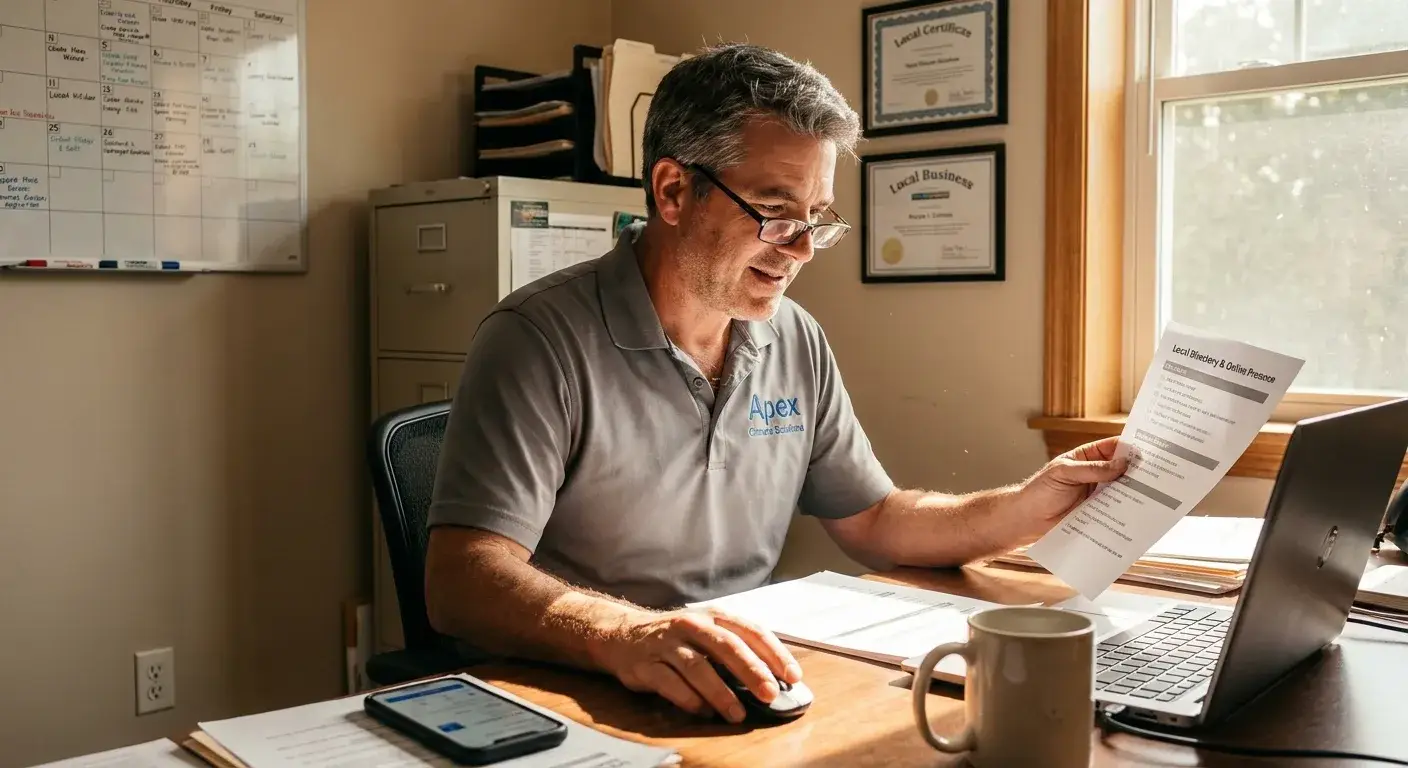
Your site needs to load in under three seconds on mobile. It needs proper schema markup so Google understands you’re a local HVAC business. It needs an SSL certificate, a mobile-friendly design, and clean URLs. According to Google’s own ranking systems guide, page experience is a direct factor in how your site is ranked.
The Compounding Effect Nobody Talks About
Here’s what most HVAC owners miss: local SEO isn’t a one-time project. It’s a compounding asset. The company that starts today has 12 months of reviews, 50 pieces of location content, and a Google profile with 500 photos when their competitor decides to start.
By that point, catching up isn’t a strategy. It’s a fantasy.
The HVAC companies we work with in Connecticut that treat local SEO as a monthly operating expense, not a one-time cost, are the ones booking calendars solid year-round. The ones who tried it for three months and quit are still cold-calling neighbors and running truck-side referrals.
Where to Start This Week
If you do nothing else this week, do these three things:
- Log into your Google Business Profile. Add 10 new photos from recent jobs. Post one update about a service you just completed.
- Text your last five customers and ask them to leave a review. Send the direct link.
- Write down every town you serve and every service you offer. That’s your content roadmap for the next six months.
Then decide whether you want to keep patching this together yourself or bring in a system that runs it every day without you thinking about it. Either way, the search results will keep updating with or without you. Only one of those outcomes puts your van in the driveway when the AC dies.