
Here is how to follow up with prospects so the quote turns into a job: get the quote opened, follow up inside the first three days, call on the big jobs instead of emailing, and keep going for about two weeks. Most yeses come fast. A real share come late, and the way most contractors run follow-up quietly gives up on them.
We did not guess at this. We pulled every residential estimate one of our clients, a landscaping and snow company here in Connecticut, sent over six months. That was 209 quotes. Here is what they showed.
What 209 estimates told us
- Customers who opened the estimate said yes 56% of the time. Customers who never opened it said yes 16% of the time.
- Half of all yeses came within 3 days of the quote going out.
- 90% of the yeses came within 16 days. The other 10% took longer.
And across every estimate the company sent this year, bigger jobs were harder to close. Under $5,000, about one in three said no. Between $5,000 and $15,000, 47% said no. Over $15,000, 73% said no.
Each of those numbers points at a different fix.
1. The quote has to get opened
A 16% close rate on unopened quotes is not a pricing problem. Those people never read the price. Most estimating software sends the quote as an email with a link, and that email lands in a promotions tab, a spam folder, or an inbox the customer checks at 10 at night.
Most guys send the quote and wait for the phone to ring. The better way is to send it by text as well as email, from a number the customer recognizes, with one line: “Here is the quote for the patio. Any questions, just reply here.” Then watch whether it gets opened. If a day goes by and it has not, that is a resend by text, not another email.
2. The first three days decide most jobs
Half the yeses came within three days. That is the window where the customer is comparing your quote to the other two they asked for, and the contractor who answers their question first usually gets the job.
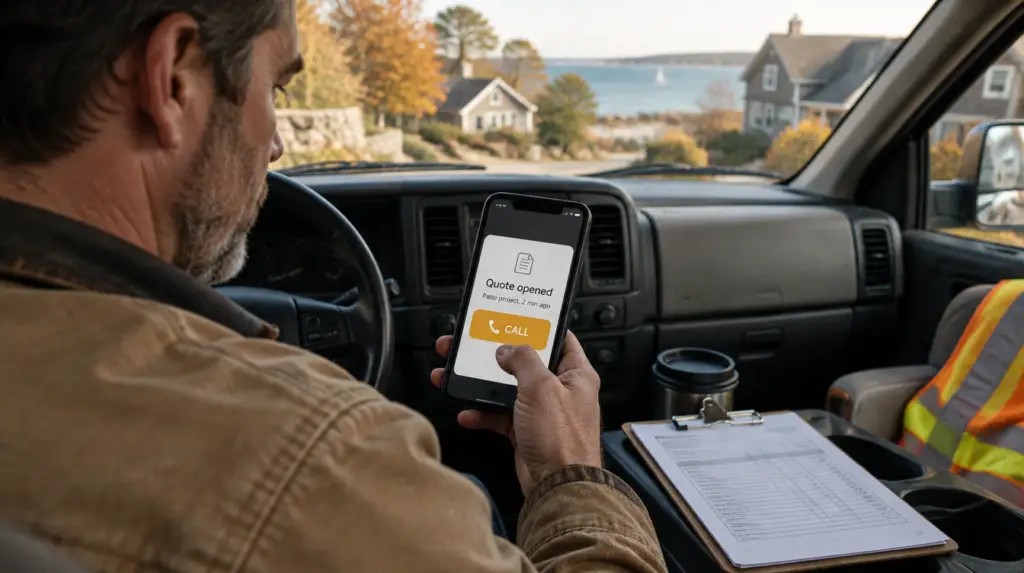
So the follow-up that matters most happens early. The moment a quote gets opened, the customer is looking at your number. A call in that hour lands while the job is on their mind. A call on day 9 lands after they have already picked someone.
3. Do not let your software quit for you
This one surprised us. The company’s estimating software sent an automatic email on day 10 telling the customer their quote had concluded. Meanwhile 10% of all yeses came after day 16. Every one of those late deciders was told the door was closed days before they made up their mind.
Check what your own software sends after the quote goes out. Turn off anything that expires a quote or tells the customer it is over. Late deciders are still buyers. They are waiting on a tax refund, a spouse, a second quote, or the weather.
4. Big jobs need a person, not an email
The bigger the job, the more often the answer was no. Over $15,000, nearly three out of four quotes were lost, and most of those were first-time customers who had never hired the company before. Nobody hands a $20,000 job to a stranger because of a well-written email.
On big quotes the follow-up is a phone call or a second walk of the property. Answer the questions they are too polite to email. Offer to split the work into phases. Ask what the other quotes included. And if they say no, make one more call to ask why. You will learn more from that call than from any report.
A follow-up schedule that works
- Day 0: send the quote by text and email.
- When it is opened: call, if the job is big enough to be worth a call. Pick your own line. For a lot of trades it is around $1,500.
- Day 3: second touch. A call on the big jobs, a short text on the small ones.
- Day 7: a text with something useful: a photo of a similar finished job, or the answer to a question most customers ask.
- Day 14: one direct ask. “Still want to get this on the schedule?”
- If they say no: one call to ask why. Then stop.
Stop everything the moment they reply or book. Nothing loses a customer faster than a “just following up” text the day after they said yes.
Why most contractors do not do this
Most guys run follow-up from memory. The quote goes out, the day fills up, and the follow-up happens if you happen to think of it between jobs. That is not a discipline problem. You were up on a roof, or under a sink, or behind a plow. Nobody remembers to send a day-7 text to eleven different people.
That is exactly why a machine should do it. When Profit Revive builds this for a business, quotes go out by text and email, an opened quote over the owner’s line turns into a call task on someone’s phone, the day 3, 7 and 14 follow-ups send themselves, and everything stops the moment the customer replies. The owner does the one thing a machine cannot: picks up the phone and talks to the customer.
If you want that running in your business, apply to become a partner and we will show you how it would work with the quotes you already send.
Frequently asked questions
How often should I follow up with a prospect who has not responded?
Four or five times over about two weeks: the day the quote goes out, day 3, day 7 and day 14, plus a call the moment they open it if the job is a big one. In the 209 estimates we studied, 90% of the yeses came within 16 days, so two weeks of follow-up covers almost everyone who was ever going to buy.
What is the best way to follow up with unresponsive leads?
First find out whether they ever saw the quote. Someone who never opened it is not ignoring you, they missed it. Resend it by text from a real number. Someone who opened it and went quiet is comparing or stuck on a question, so call them. Customers who opened their quote said yes 56% of the time; customers who never opened it said yes 16% of the time.
How do I write a follow-up message that gets a reply from a homeowner?
Short, from a person, about their job, with one easy question. For example: “Hi Sarah, it is Mike from the patio quote. Any questions on it? Happy to walk you through it.” No “just checking in,” no paragraphs, and never a message that says the quote has expired.
What follow-up software works best for a small service business?
Whatever you use has to do four things: send the quote by text as well as email, tell you when it was opened, send the follow-ups on a schedule without you remembering, and stop the moment the customer replies or books. Most estimating software sends the quote and stops there. That gap is what a follow-up system fills.