

Good HVAC website design is not about looking pretty. It is about turning the guy who just Googled “AC not blowing cold” at 9pm into a booked service call on your calendar by 9:15am tomorrow. Most HVAC sites do not do that. They sit there like a digital business card while the phone stays quiet.
We build sites for trade businesses every week, and the gap between an HVAC site that books jobs and one that just exists comes down to a handful of specific things. Not design trends. Not fancy animations. Real, boring, revenue-driving details that most contractors skip.
What Should a Good HVAC Business Website Include?
Strip everything else away and a working HVAC site needs seven things. Miss any of them and you leak leads.
- A phone number in the top right, sticky on mobile, tap-to-call
- A clear service area (the exact towns you cover, not “the greater metro area”)
- Service pages for every job you actually want more of (AC repair, furnace repair, install, maintenance, ductwork, IAQ)
- Real photos of your trucks, your crew, and finished installs, not stock images of a smiling family adjusting a thermostat
- A short form above the fold on every service page (name, phone, address, issue, that is it)
- Google reviews pulled in live, not screenshots from three years ago
- Emergency and after-hours language front and center if you take those calls
That is the floor. If your current site is missing any of these, you are handing jobs to competitors who have them.
What Do the Best HVAC Websites Do Differently to Generate Leads?
Here is where it gets interesting. The best HVAC sites do three things that mid-tier sites do not.
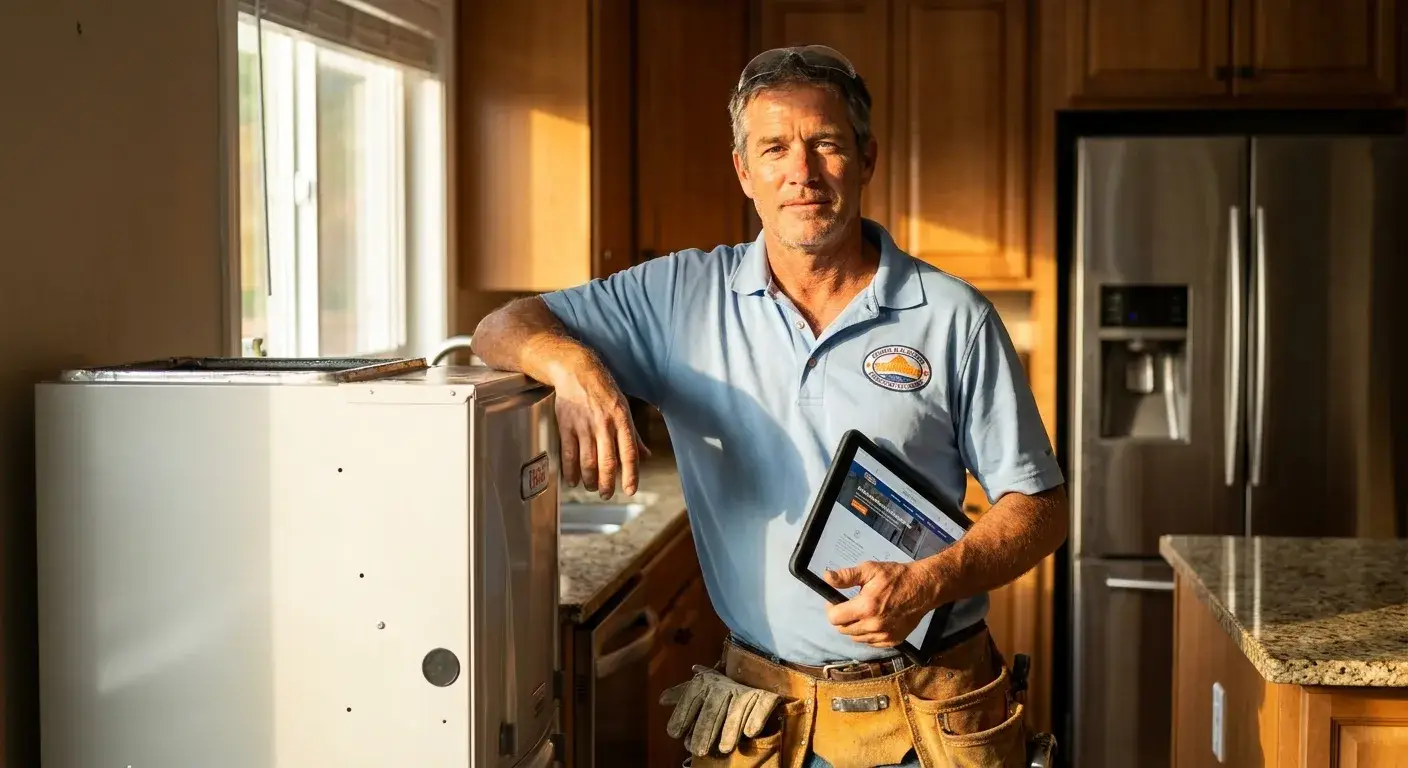
1. They Assume the Visitor Is Panicked
Nobody Googles “HVAC repair near me” because they are having a good day. Their furnace died in January, or the AC quit in July with the mother-in-law visiting. The best HVAC sites write copy that meets that person where they are. Short sentences. Plain language. No corporate voice about “excellence in comfort solutions.” Just: “Your AC quit. We can be there today. Call this number.” That is it.
2. They Have a Real Follow-Up System Behind the Form
This is the part nobody sees, and it is the part that actually books the job. A form submission at 11pm needs to trigger an SMS to the homeowner within 60 seconds saying “Got your request, we will call you at 7am to confirm the appointment.” Most HVAC sites send a form and then nothing happens until Monday. By Monday the homeowner called three other companies. A working site is wired into a CRM that follows up automatically. See our approach to custom software and CRM setup for trade businesses for how this actually gets built.
3. They Rank for the Right Keywords
The best HVAC sites are not trying to rank for “HVAC company.” They are ranking for “furnace not igniting Bristol CT” and “AC leaking water in attic Farmington.” Long-tail, panic-driven, town-specific searches. That is where the money is, and it takes a real local SEO strategy for contractors to get there. Not a WordPress plugin. Not a checkbox.
How Do I Build an HVAC Website That Books Service Calls?
Building an hvac website design that actually books service calls is a process. Here is the order that works.
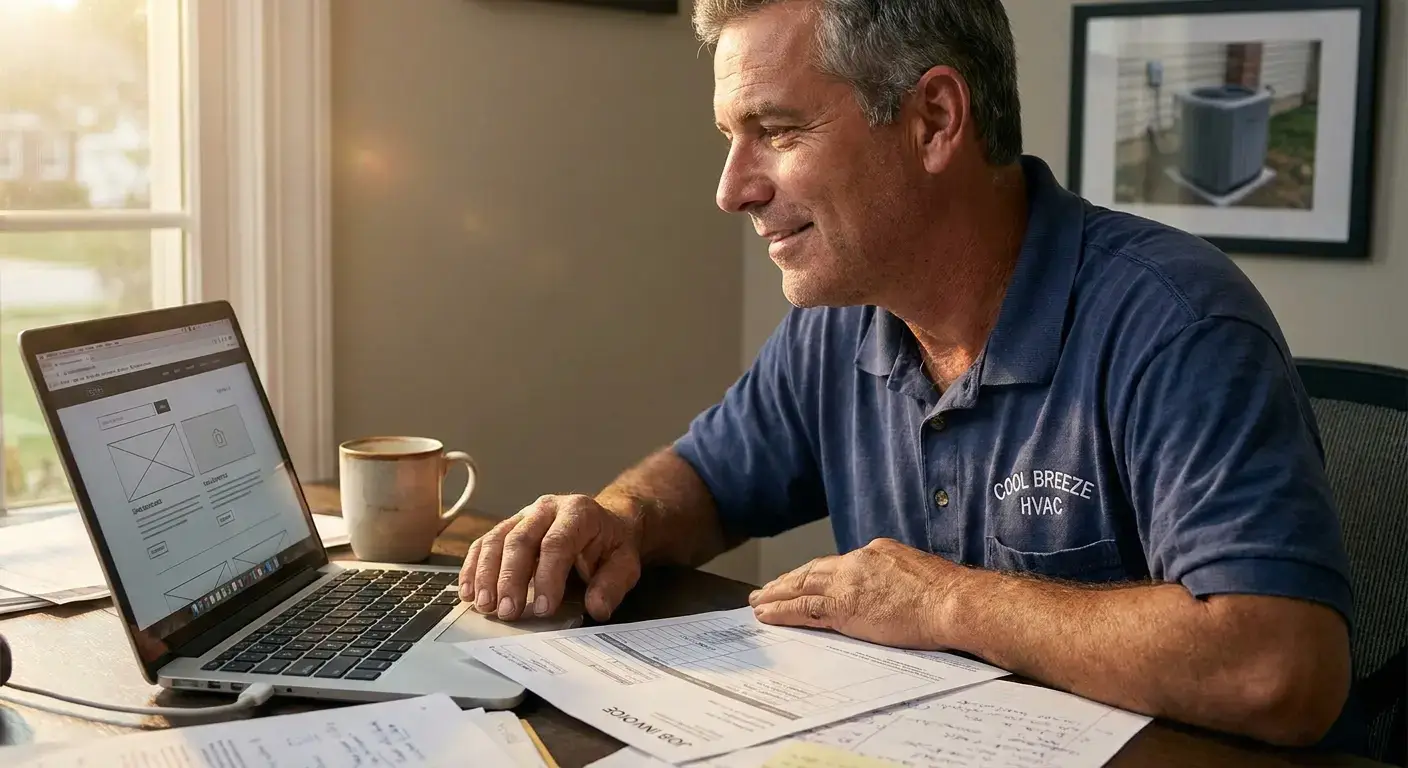
- Start with your service area. Write down every town you actually service. Not aspirational towns. Real ones. Each of those towns will eventually get its own landing page.
- Map your services. List the specific jobs you want more of. Not “HVAC services.” Real jobs: R-410A leak repair, gas furnace install, mini-split install, duct cleaning, IAQ assessment. Each gets a page.
- Write like a technician talks. The homeowner does not know what a heat exchanger is. They know their heat is out. Write to that.
- Put phone and form on every page. Above the fold. Sticky on mobile. Not buried in a contact page.
- Wire the form to a CRM. Automated SMS confirmation within 60 seconds. Automated email confirmation. Alert to your dispatcher’s phone. This is non-negotiable.
- Add real proof. Photos of your trucks. Photos of your crew. Google reviews pulled live. Not stock photos.
- Build for speed. Site loads in under 2 seconds on a phone or you lose 40 percent of visitors before they see anything.
The Google Core Web Vitals guidelines spell out exactly what “fast enough” means. If your site fails those metrics, you are penalized in search results before a homeowner even sees you.
Which Website Builder Is Best for an HVAC Business?
Short answer: WordPress with Elementor, hosted somewhere fast, wired to a real CRM.
Longer answer: it depends what you want the site to do. If you want a brochure, use anything. If you want the site to book jobs while you sleep, you need something that can integrate with a CRM, handle local SEO properly, and get updated fast when your service area changes or you add a new service line. That rules out most drag-and-drop builders like Wix or Squarespace, which look fine but hit a wall on customization and SEO the second you try to scale.

The setup we run for HVAC clients is WordPress plus Elementor for the build, GoHighLevel behind it for the CRM and automations, and a proper local SEO layer on top. It is the same stack we use for every trade we serve. See our full web design approach for contractors for how we put it together.
The Part Nobody Talks About: What Happens After the Lead Comes In
Here is the truth most website conversations skip. The best hvac website design in the world does not matter if the lead sits in an inbox for four hours. We built a system for a tree service in New London County, CT called Denison Tree Removal. Same idea applies to HVAC. Before we came in, they were doing $19,000 in November. After we built their site, CRM, and follow-up automation, that same November hit $113,000 the next year. Same crew. Same trucks. Same service area. The difference was catching every lead and following up in seconds instead of hours.
That is what HVAC website design is actually for. Not to win a design award. To make sure the phone rings, the form fills out, and the automation books the call before the homeowner has time to call the next guy.
What to Do Next
Look at your current HVAC site on your phone right now. Can you tap the number in the top right? Is there a form above the fold? When did you last update the photos? Are your Google reviews showing live? If any of those answers are no, that is where the leaks are.
If you want to see what a real growth system looks like for an HVAC business, take a look at how we approach this for trades or reach out for a walkthrough. The site is the front door. What sits behind it is what actually books the jobs.