
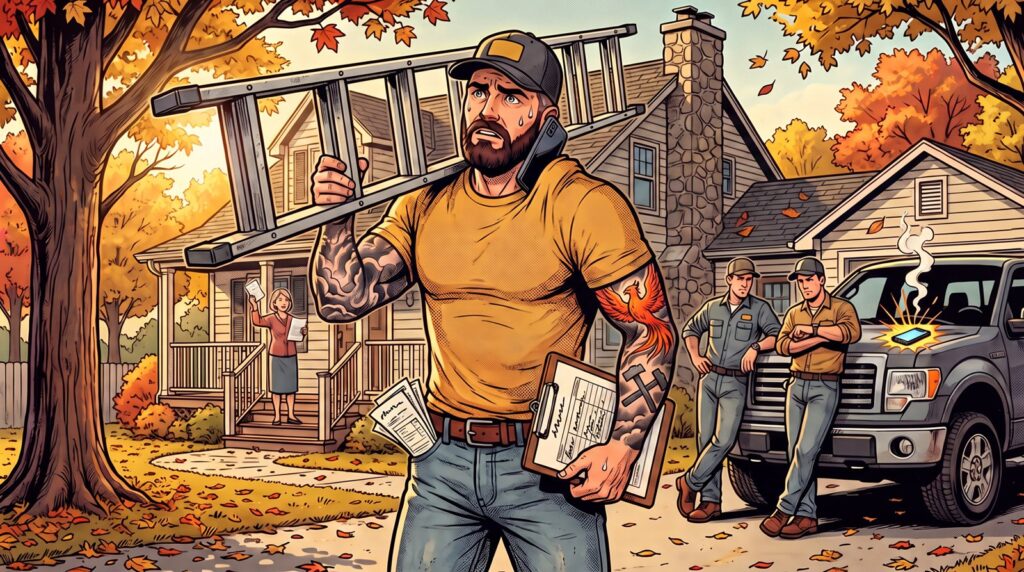
Growing a trade business stalls at the same spot for almost everyone: the owner is the only person who answers the phone, sends the quotes, asks for reviews and chases the money. You cannot fix that by working more hours. You fix it by taking four jobs off your plate in order, starting with the phone, and letting a system do them the same way every time.
Meet Mack. He is great at the work. His customers love him, his crew shows up for him, and his town knows his truck. He is also the bottleneck on every single thing that happens in his business, and he does not see it, because he is too busy being the bottleneck.
If that is you, here is the order to fix it in.
Sound familiar?
- You are on a roof, a ladder or under a sink when most of your calls come in.
- Quotes go out at 10pm from the truck, when you finally have a minute.
- You know you should ask for reviews. You ask maybe one customer in ten.
- You missed something with your family this month because the phone rang.
Two or more of those, and the problem is not your work or your prices. It is that every job in your business still runs through one person.
1. The phone: the job you are worst at because you are working
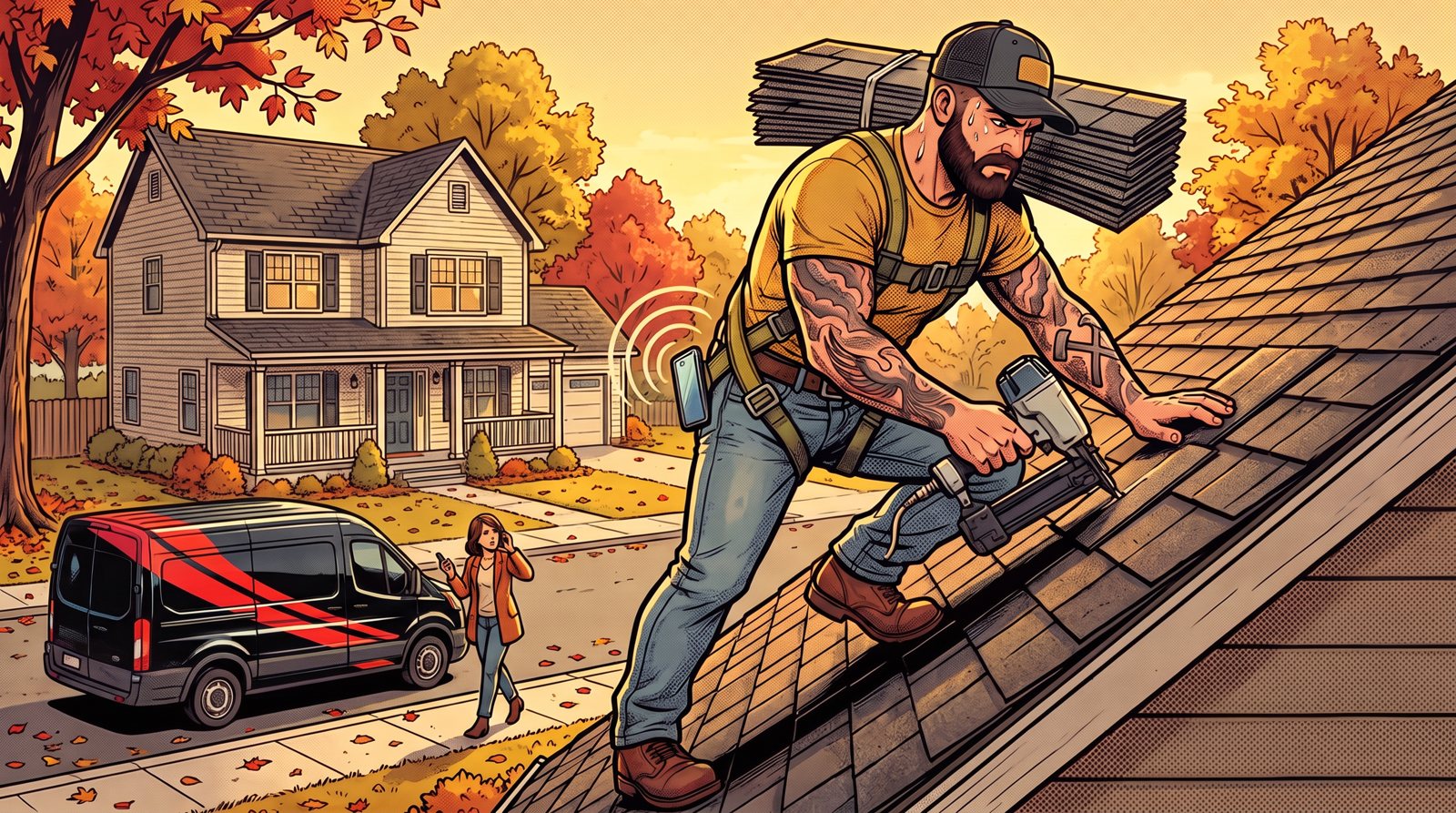
The phone rings when people need you, and people need you while you are on the job. That is the trap. The better you are booked, the more calls you miss.
It is not just daytime. A dumpster rental company here in Connecticut that we work with looked at when its customers actually booked online: 7 of 8 checkouts happened outside office hours. Nights and weekends are when homeowners finally sit down and deal with the project. If the only way to reach you is you, those people go to whoever answers.
The manual fix most owners try is calling everyone back at the end of the day. By then the homeowner has called two other companies. Here is how missed call text back works for home service businesses.
What to hand off: every missed call gets an instant text back with your name, a question about the job, and a link to book. A missed call becomes a conversation in under a minute, and you call back the ones worth calling from the truck, already knowing what they need.
2. The quote: the job you do at 10pm in the truck

Sending the quote is the easy part. The job is won or lost after it lands. A landscaping and snow company in Connecticut we work with went through 209 estimates and found two things that change how you should handle every quote:
- When the customer opened the estimate, they said yes 56% of the time. When they never opened it, 16%.
- The median customer said yes in 2.9 days. 90% of the yeses came within 16 days.
So the first few days after a quote decide most jobs, and the biggest single lever is just getting it opened. An owner doing this by hand from the truck at night cannot keep up with that window. A system can: a text when the quote goes out, a nudge if it is not opened by the next day, a check-in on day three, and a real phone call on the big ones. We laid out the full schedule in how to follow up with prospects so you actually book the job.
3. Reviews: the job nobody does
Your best work only sells the next job if someone says so where the next customer is looking. That is your Google rating. The same landscaping company had 27 reviews at a 4.3. Every competitor beating them in the map results sat between 4.7 and 5.0, some with fewer reviews. The gap was the rating, not the count.
Their first review request, a single generic message, went to 120 customers and got 3 reviews back. That is what a weak ask gets you. A good ask goes out the day the job finishes, while the customer is still looking at the work, names the job, and makes leaving the review a one-tap link. Then it asks once more a few days later if they have not done it.
What to hand off: the ask itself. You should never have to remember it. The job closes, the request goes out.
4. Your time: the job you keep giving away

This is the one nobody puts on a spreadsheet. When every lead, quote and callback depends on you, your evenings and Saturdays belong to the phone. Most owners we talk to did not start a business to be on call for it seven days a week.
The point of handing off the first three jobs is not to step back from the work. It is that the business keeps answering, quoting and asking for reviews whether or not you are standing in the parking lot. You still close the big jobs. You still talk to your customers. You just stop being the only thing holding it all together.
The order matters
- Phone first. It is where the most money leaks, and it is the fastest to fix.
- Quotes second. You already paid to get those customers to the estimate. Do not lose them after it.
- Reviews third. A better rating makes every ad, listing and referral work harder.
- Then hire. Once the first three run on their own, your first office hire is managing a system, not inventing one.
Most owners do it backwards. They hire a person to answer the phone before anything is written down, and that person ends up as overloaded as they were.
Quick answers
When should a trade business owner stop doing everything themselves?
When you are missing calls during jobs, sending quotes late at night, or not asking for reviews because you forget. Those are signs the business has outgrown one person, usually well before revenue says so.
What should I hand off first when growing a trade business?
The phone. Missed calls are the most expensive leak and the easiest to fix with an instant text back and online booking. Quote follow-up and review requests come next.
Do I need to hire an office manager to grow?
Not first. Put the phone, quote follow-up and review requests on a system, then hire. A new hire running a system you already have does far better than one trying to build it.
How fast do customers decide after getting a quote?
Fast. One Connecticut landscaping company found the median yes came in 2.9 days, and 90% of yeses within 16 days. Follow-up in the first three days matters most.
Get your Saturdays back

You do not need to work harder. You need the four jobs that only you do today to run without you. That is what we build for owner-run trade businesses: the missed-call text back, the quote follow-up, the review ask, all running in the background while you work. If you want to see what that looks like in your business, apply to become a partner.