
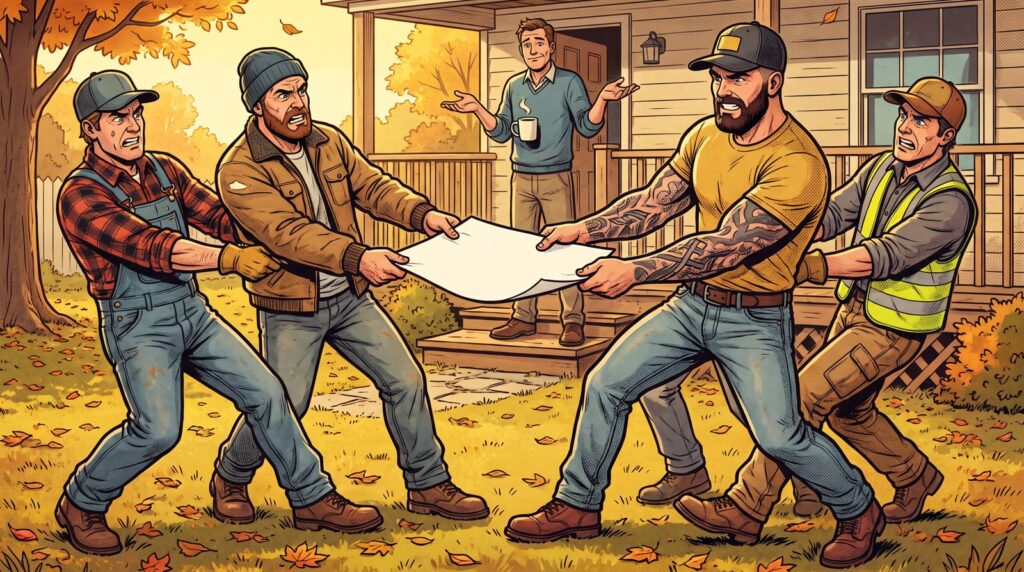
Here is the trap. Lead sites and a lot of pay per lead agencies sell one homeowner’s request to several contractors at the same time. The homeowner picks whoever calls first or quotes lowest, so you compete on price instead of on your work, and you pay for every lead, even the ones who never pick up. Below is how to check what your leads really cost, the exact words to use when you do get one on the phone, and a 30 day plan to build leads that only call you.
How the shared lead trap works
A homeowner fills out one form: “Get quotes from local pros.” That request goes to several contractors in the area. Each one pays for it. Every phone rings at once.

Now look at it from the homeowner’s side. Within an hour they have missed calls and texts from companies they never heard of. They answer one or two. Whoever gets through first sets the price everyone else gets measured against. Your reviews, your insurance and the way you leave a property never get a look. They see a number.
And you never own anything. The lead site keeps the homeowner. Next spring it sells that same house to you and the rest of the list again.
Do the math: what one booked job really costs you

Most owners judge leads by the price per lead. That is the number the lead seller wants you to look at. The one that matters is cost per booked job. Pull last month’s numbers and fill this in:
| Line | Your number |
|---|---|
| A. Total spent on lead sites and lead agencies last month | $ |
| B. Leads you got | |
| C. Leads you actually talked to | |
| D. Jobs you booked from those leads | |
| Cost per booked job = A divided by D | $ |
To show the math with made up numbers: if you spent $1,200, got 20 leads, talked to 9 and booked 2 jobs, each job cost you $600 before you bought a single material. Then ask whether those 2 jobs were at your price or at the lowest price on the list. Most owners who do this once for a full month stop renewing on their own.
5 signs the leads you buy are shared
- The homeowner mentions other companies already called.
- You pay per lead whether or not you ever reach the person.
- The seller can’t show you the ad, page or search that produced the lead.
- The request came from a generic “get quotes” form, never from someone who searched your name.
- If you stop paying, you keep nothing: no list, no reviews, no website traffic.
If you are still buying them, win on value, not price
You may not be ready to cut the lead sites off this week. Fine. Here is how to win more of the ones you already paid for. Copy these word for word and change the bracketed parts.
The first call
Don’t open with a price. Open with their problem, and let them tell you what matters. On the phone:
“Hi [name], it’s [you] from [company], you asked about [job]. Before I throw a number at you, can I ask what’s going on with it? … Got it. Have you talked to anyone else yet? … What would make you pick one company over another?”
The last question is the one that matters. Whatever they say (show up on time, clean up, don’t wreck the lawn, call me back) is what you sell for the rest of the call. Now you are not a number on a list. You are the one who asked.

The text when you can’t pick up
You are on a roof. The lead is going to the next guy in two minutes. Send this from your business number:
“Hi [name], it’s [you] from [company]. Got your request about [job]. I’m on a job right now, what’s the best time to call you today?”
It ends on a question on purpose. A question gets a reply, and a reply means they are now talking to you, not the list.
The quote follow-up
Most shared leads die after the quote, because nobody follows up. Send these, one per message, a few days apart, and stop after the third if they never answer:
Day 1: “Hi [name], just wanted to make sure the [job] estimate came through okay?”
Day 3: “I was just curious what your thoughts were on the [job] estimate?”
Day 7: “Have you given up on getting the [job] done this year?”
Two rules. Never paste the estimate link into a text to someone who hasn’t answered you. Ask “want me to send it over again?” and send the link after they say yes. Texting links to people who never reply is how a business number gets flagged as spam, and then even your real customers stop getting your texts. And keep it to one question per message.
Getting the estimate opened is worth the effort. A landscaping and snow company we work with here in Connecticut looked at its own book: estimates the customer opened closed at 56 percent, and estimates never opened closed at 16 percent.
5 questions to ask any lead seller before you pay
- How many other contractors get the same request?
- Where do the leads come from? Show me the ad or the page.
- What happens when the number is fake or the person never answers? Do I get a credit, and how?
- Do I get the homeowner’s info to keep if I stop paying you?
- Can you report cost per booked job, not cost per lead?
If they won’t answer the first two straight, you have your answer.
The 30 day plan to get out of the trap
The way out is leads where you are the only company the homeowner is talking to. Those come from places where they find you by name.
- Week 1: your Google Business Profile. Every service you do, every town you cover, real job photos, your hours. When someone taps your listing from a search, nobody else got that call. More on why that matters in why local service businesses lose leads.
- Week 2: reviews. Ask every happy customer from the last few months. Ask with a question first (“how did everything turn out?”), then send the review link to the ones who say it went great.
- Week 3: your website. On a phone, in a few seconds, it should say what you do, where, and how to book. Here is how to turn website visitors into booked jobs.
- Week 4: the text back and the follow-up. Set up the missed call text and the three quote follow-ups above so they go out every time, not just on the days you remember.
Keep the lead sites running as a bridge while this builds, and track them by cost per booked job. For a trade by trade version, see how plumbers get leads without aggregators.
Quick answers
Are shared leads worth it for contractors?
Sometimes, as a stopgap in a slow week. As your main source of work, rarely. You compete on price against everyone who got the same request, and you pay for every lead whether it books or not.
What is the difference between a shared lead and an exclusive lead?
A shared lead is one homeowner request sold to several contractors at once. An exclusive lead goes only to you, usually because the homeowner found you directly through your Google profile, your website or a referral.
How do I know if a lead was sold to other contractors?
Ask the homeowner who else they have talked to. If other companies called within minutes of their request, or it came from a generic quotes form, it was almost certainly shared.
How fast should I respond to a shared lead?
Before anyone else does. If you can’t call right away, send a text that asks one easy question, like the best time to call. A reply puts you ahead of the companies still leaving voicemails.
Get out of the shared lead trap for good
Everything above works by hand. The catch is doing it every single time while you run jobs. Profit Revive builds the system that does it for you: leads that only call you, a text back on every missed call, and follow-up on every quote that asks first and sends the link after a yes. If you are done paying for the same lead as everyone else in town, apply to become a partner.