
If you want to get more Google reviews and stop losing local jobs to the contractor down the road with 400 five-star ratings, you need a system, not a sticky note on the dashboard of your truck. Most contractors I talk to know reviews matter. They just have no consistent way to ask. The job ends, the check clears, the homeowner moves on, and the review never happens.
That is the real problem. It is not that your customers do not like you. They do. They just forget. And without a system that asks at the right moment, in the right channel, with one tap to leave the review, you are leaving free local search rankings on the table every single week.
Why Google Reviews Decide Who Wins Local Search
Google’s local algorithm rewards three things above almost everything else: proximity, relevance, and prominence. Prominence is mostly driven by review count, review velocity, and review recency. Translation: the contractor with 312 recent reviews beats the contractor with 47 old ones, even if the 47-review shop does better work.
This is why two electricians in the same town can have wildly different phone-ring rates. One shows up in the Google Map Pack on every “electrician near me” search. The other shows up on page two. The work is comparable. The review pipeline is not.
According to BrightLocal’s Local Consumer Review Survey, the vast majority of consumers read reviews before hiring a local business, and most will not consider a contractor with fewer than 10 recent reviews. Recency matters as much as volume. A review from 2021 does almost nothing for you today.
Why Manual Review Requests Always Fail
Here is what manual review collection looks like for most trades:

- The crew finishes the job and forgets to ask.
- The owner remembers two days later and texts the customer a long link.
- The customer means to do it, opens the link, gets confused, closes the tab.
- Nothing happens.
Even disciplined contractors who hand out cards or print QR codes get maybe a 5 to 10 percent response rate. That is not a system. That is hope. To actually get more Google reviews at the pace local search rewards, you need automation that fires the moment a job is marked complete, hits the customer on the channel they actually check, and makes the review take 20 seconds, not five minutes.
The Autopilot Review System That Actually Works
This is the exact structure we build inside our growth systems for trade businesses. It runs inside the CRM and fires without anyone on your team thinking about it.
Step 1: Job Completion Triggers the Sequence
When a crew marks a job complete in the field (in the CRM, on the invoice tool, or via a simple “done” tag), the system kicks off automatically. No manual sending. No remembering. The trigger fires within minutes of job close, which is exactly when the customer is happiest with the work.
Step 2: SMS First, Email Backup
Text messages get opened. Email mostly does not. The first ask goes out as a short, owner-voice SMS within 30 to 60 minutes of job completion. Something like: “Hey Sarah, this is Mike from Webb Tree. Crew said the removal went smooth. Mind dropping a quick Google review? Takes 20 seconds: [link]” If no response in 48 hours, an email follows with the same tone and the same one-tap link.
Step 3: Smart Link, Not Long Link
The link goes directly to your Google review form, pre-filled, with the five-star prompt already on screen. Not your homepage. Not your GBP profile. Straight to the write-a-review screen. This single change typically doubles response rate.
Step 4: Negative-Review Buffer
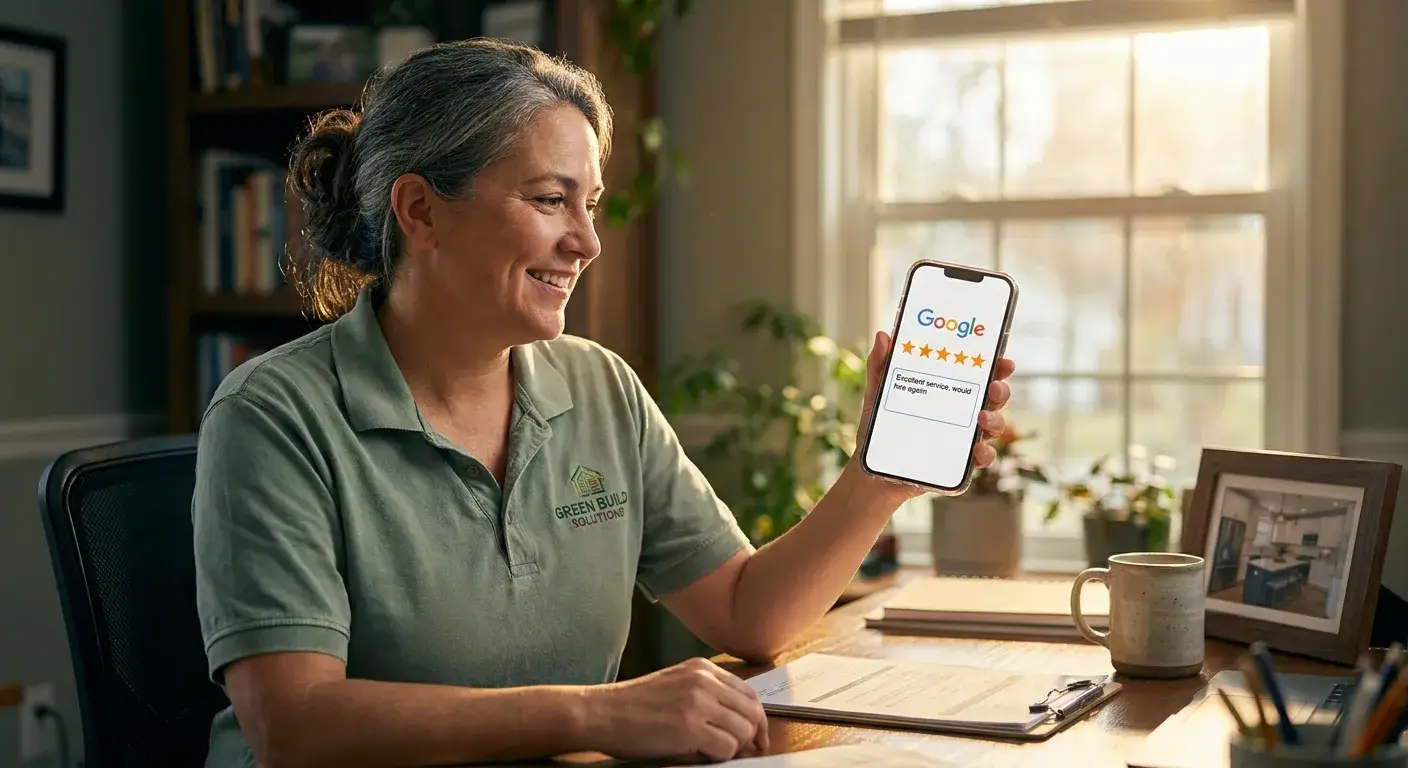
Before the public link, the system asks a private one-tap question: “How did we do, 1 to 5 stars?” If they tap 4 or 5, they get the public Google link. If they tap 1 to 3, they get a private feedback form that routes straight to the owner’s phone so you can fix it before it becomes a public one-star. This is legal under Google’s guidelines as long as you are not paying for reviews or filtering after they are posted, and it saves contractors from preventable damage.
Step 5: Follow-Up Cadence
Most customers who do not respond to the first text just need a reminder. The system sends a polite second nudge at 72 hours and a final one at 7 days. After that, it stops. No badgering.
What Happens to Your Local Rankings
Contractors who turn this system on typically see a five to ten times jump in review velocity within 60 days. A roofer doing 15 jobs a week who previously collected one review a month starts collecting 8 to 12. A tree crew doing 30 removals a week starts pulling 15 to 20 reviews monthly. Google notices. Map Pack rankings move. Phone calls follow.
This is the same mechanic behind the results on our case studies page. Better systems, not bigger ad budgets, are what move the needle for owner-operated trade businesses.
What to Do This Week
If you want to get more Google reviews starting now, do three things:
- Audit your last 30 completed jobs. How many turned into reviews? If it is under 30 percent, you have a system gap, not a customer gap.
- Pick the channel your customers actually use. For trades, that is almost always SMS first.
- Stop asking with a long link. Use a direct review URL that opens to the five-star prompt.
The contractors winning local search are not better marketers. They are better at catching the leads and the reviews they already earn. That is the whole game.